

Semiconductors fall into bear market territory
Wall Street closed out a rough week on Friday, with the S&P 500 down about 1%, the Nasdaq 100 off roughly 1.4%, and the Dow the relative outperformer at down 0.8%. The real damage was concentrated in chips: the Philadelphia Semiconductor Index sold off hard into the close, finishing down 1.6% on the day and, in the process, officially crossing into bear-market territory — down some 20% from its peak. Nvidia alone was the single biggest drag on the index, and breadth was ugly across the board, with more than 350 S&P names lower against roughly 140 higher.
S&P 500 1.0% ↓ || 7,460
Nasdaq 1.4% ↓ || 25,525
Dow Jones 0.8% ↓ || 52,150
Table of Contents
SOX Rotation (main story)
Economy and the Big Picture
Other Notables
The Reallocation of the America Food Dollar (premium)
The Portfolio Goat app
New Link Roundup (new)
Premium Research Links
As a premium subscriber to OpenFieldbook newsletter, be sure to take advantage of your access to the complementary OpenFieldbook app, or upgrade your membership.
Main Story
The chip unwind is really a fight over one question: was this just profit-taking after a parabolic run, or is something more structural shifting underneath the AI trade?
For months the story was simple — chip executives kept telling investors that demand was so strong they were sold out years in advance, and stocks like Micron MU 0.00%↑ran 200% to 300% on it. That kind of move was always going to invite profit-taking, and the last two weeks look a lot like exactly that: DRAM-linked names fell into their own bear market first, then dragged the broader index down with them, with GlobalFoundries GFS 0.00%↑ down 16% and SanDisk SNDK 0.00%↑ down 30% over just the past week.
But there’s a second, less comfortable read too. The hyperscalers have been ramping capex aggressively, and the market is starting to ask how fast that spending actually turns into ROI — and what happens to the chip trade if Big Tech ever eases off the gas. Bank of America, for its part, is staying bullish, arguing that order backlogs remain hot, that AI ROI is visibly improving as models get more efficient, and that free cash flow — squeezed now by heavy spending — should start recovering as soon as 2028. The bank even argued that cheap, open-weight Chinese models are, if anything, good for the compute trade even where they threaten proprietary-model economics at the frontier labs.
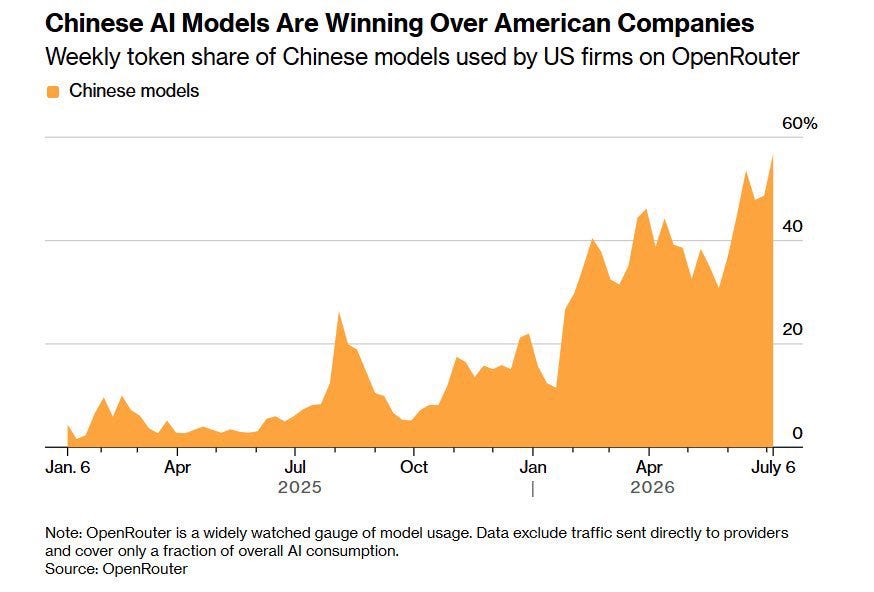
That China dimension got a jolt of its own this week. Moonshot’s new open-weight model, Kimi K3, landed just behind the current US frontier — Anthropic’s Claude Fable 5 and OpenAI’s GPT-5.6 Soul, both roughly a month old — while remaining freely downloadable, with Moonshot instead charging for hosted inference and commercial API access.
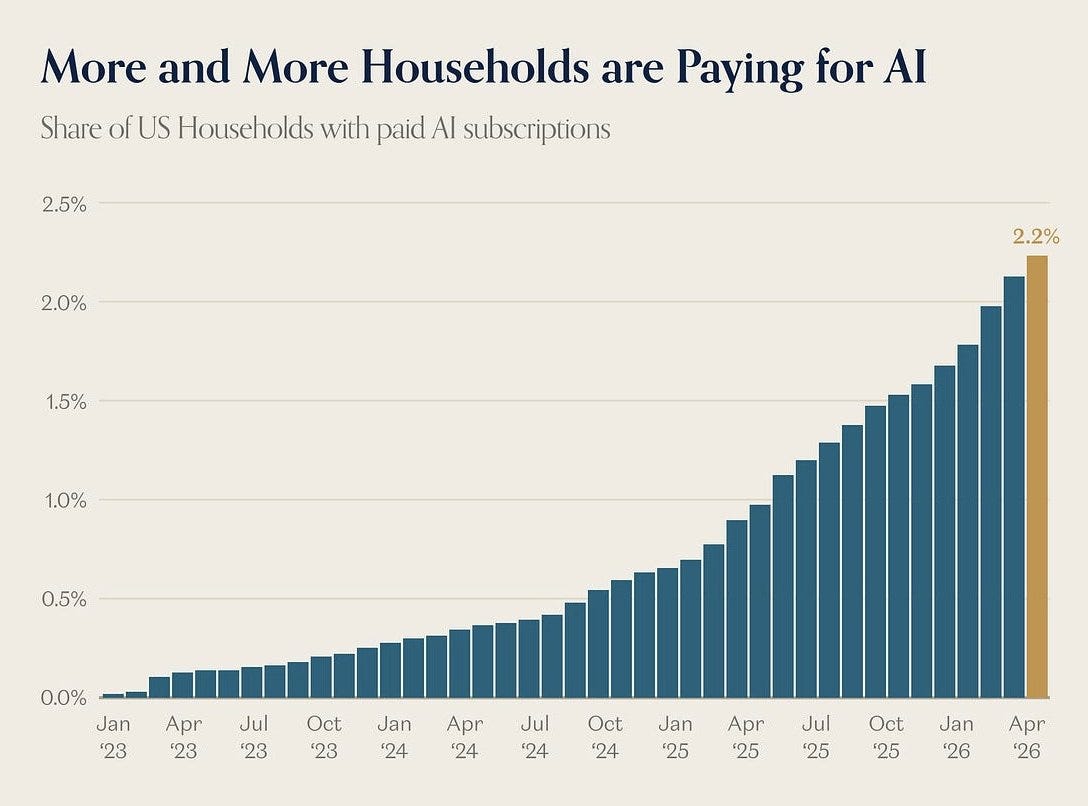
The gap between Chinese and US labs, by most accounts on the desk, is closing faster than it was even a few months ago. Meanwhile Anthropic’s own numbers keep climbing: one venture investor pegged the company’s annualized revenue run rate near $60 billion, up from roughly $47 billion previously reported, growing at something like 10x year-over-year — a pace he said has no real precedent in any public or private company anywhere. He thinks Anthropic could turn profitable this year, earlier than expected.
Economy and the Big Picture
Big tech earnings, due imminently, are the real test of all of this. Q2 consensus sits near 23% aggregate growth; stack that against Q1 and it would be the only back-to-back 20%-plus stretch outside a recession trough. The market is priced at roughly 23 times forward earnings, so if the hundreds of billions in AI capex don’t start showing up as earnings and cash-flow growth rather than just spending, strategists expect the market to take a step back.
Away from tech, oil is creeping higher on two separate threads. Brent settled near $87–88 a barrel, up about 4% on the week, driven partly by simmering US-Iran tension and partly by the older, still-live risk that Houthi forces in Yemen could close the Bab-el-Mandeb Strait, the corridor that Saudi Arabia’s Red Sea-bound oil exports depend on after moving overland from the Gulf.
Other Notables
Elsewhere, SpaceX SPCX 0.00%↑ remains the market’s most volatile new listing: William Blair turned more bullish on the launch business and sees 40%-plus upside, even as the stock trades below its $135 IPO price and has shed roughly $1 trillion in value from its post-listing peak. The bull case rests on Starlink — adding a million subscribers a quarter, on pace for 12 million by quarter-end, already fiber-competitive — plus a fast-growing sideline renting data-center capacity to hyperscalers, including deals with Google and Anthropic. The bear case is simply that full Starship reusability is a multi-year, maybe decade-long engineering slog. Netflix NFLX 0.00%↑, meanwhile, fell another 7% after a second straight quarter of decelerating growth, though the company is leaning hard on live sports — six of its ten biggest sign-up days ever are tied to live events — and an ad business scaling toward $3 billion this year, still a fraction of YouTube’s roughly $60 billion.
And on the credit side, a quieter worry is building: bonds issued by hyperscalers to fund the AI buildout are trading at their widest spreads ever versus the broader market, even as insurers — who hold about a quarter of US corporate debt — are reportedly nowhere near their concentration limits on any single issuer. The tension for now looks more like a pricing-and-timing question than a real risk-limit problem, but it’s the kind of thing that tends not to stay quiet forever.
