IBM's worst session since 1968
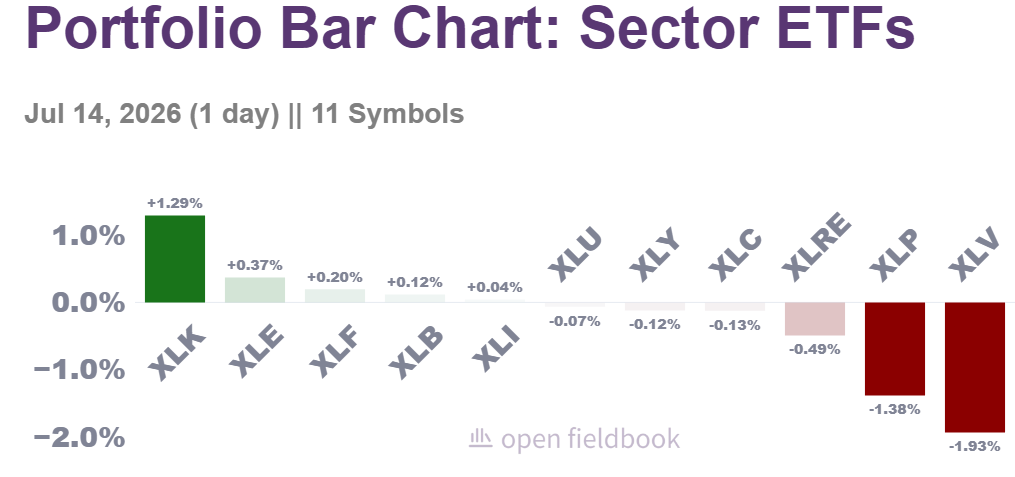
Wall Street closed mixed but resilient Tuesday even as the geopolitical backdrop darkened by the hour: hours after a cooler-than-expected CPI print sent the Nasdaq 100 up 1.1% and eased pressure on Treasury yields, the U.S. military confirmed it had resumed strikes on Iranian targets and reinstated a naval blockade of Iranian ports, sending Brent crude toward $85 a barrel. The S&P 500 finished with negative breadth — 296 decliners against 204 advancers — masked by a concentrated rally in Information Technology (+1.3%), while Health Care (-1.9%) and Consumer Staples (-1.4%) dragged. The Dow eked out a 30-point gain and the Russell 2000 added 12 points. The 10-year yield slipped two basis points to 4.59%, and the 2-year fell roughly 10 basis points, as traders bet the Fed is in no hurry to move despite Chair Kevin Warsh’s hawkish tone on Capitol Hill, where he told Congress the CPI cooldown was not “mission accomplished” and reiterated his opposition to formal forward guidance.
S&P 500 0.4% ↑ || 7,545
Nasdaq 0.9% ↑ || 26,100
Dow Jones 0.0% ↑ || 52,500
Table of Contents
IBM’s earnings reaction (main story)
Economy and the Big Picture
Other Notables
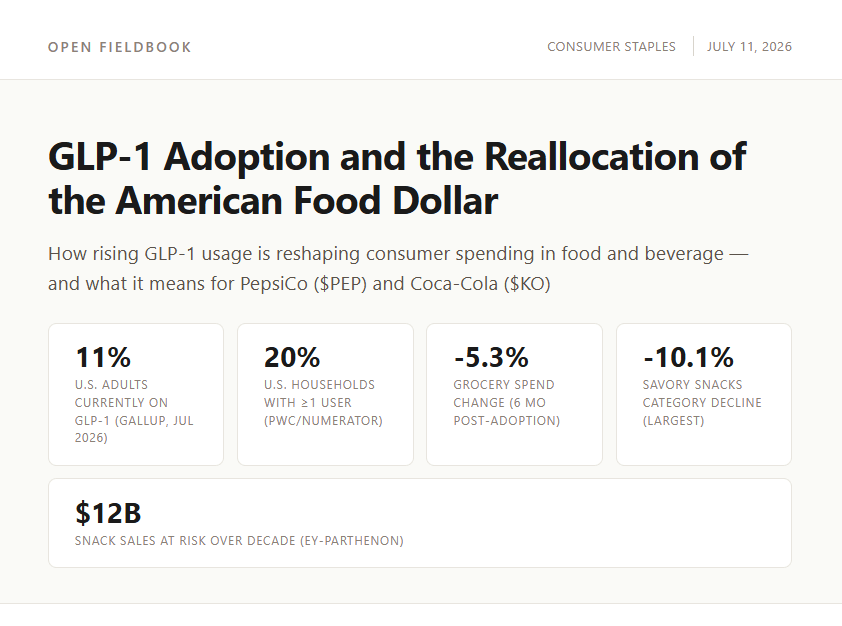
The Reallocation of the America Food Dollar (premium)
The Portfolio Goat app
New Link Roundup (new)
Premium Research Links
As a premium subscriber to OpenFieldbook newsletter, be sure to take advantage of your access to the complementary OpenFieldbook app, or upgrade your membership.
Main Story
The day’s real carnage was reserved for IBM IBM 0.00%↑, down 25%, which suffered its worst single session since 1968 after CEO Arvind Krishna warned the company lost out on tens of software and consulting deals as enterprise customers redirected spending toward higher-priced memory and storage hardware — collateral damage from the ongoing DRAM shortage.
The stock’s slide dragged the broader software complex down about 1.6%, with the IGV ETF now off 11% year-to-date versus infrastructure names like Caterpillar CAT 0.00%↑ and GE GE 0.00%↑ up 40–200%; one analyst estimated roughly 70% of covered software names are seeing decelerating growth as enterprise AI adoption stalls on governance and security concerns. Cybersecurity was the exception, with CrowdStrike CRWD 0.00%↑ and Okta OKTA 0.00%↑ (+80% YTD) underscoring just how uneven the “software” trade has become.
Chips, by contrast, had one of their best days in weeks. The Philadelphia Semiconductor Index rose about 3%, with Nvidia NVDA 0.00%↑, Intel INTC 0.00%↑, Micron MU 0.00%↑ and AMD AMD 0.00%↑ all firmly higher — KeyBanc lifted its AMD price target to $725 from $530 on strong AI data-center demand, and Bank of America raised its own target to $620. DRAM and memory names led the tape, even as the group remains roughly 25% below its highs and the same memory squeeze that’s pressuring IBM is now showing up in global smartphone shipments, which fell 11% year-over-year in the second quarter — the steepest Q2 decline in 13 years, per Counterpoint Research — as thin-margin, sub-$400 devices bear the brunt of rising component costs.
Economy and the Big Picture
Bank earnings offered a study in contrasts: JPMorgan JPM 0.00%↑ and Goldman Sachs GS 0.00%↑ both closed at records, with JPMorgan posting its highest quarterly profit ever and Goldman notching a third straight quarter of record equities-trading revenue, while Citigroup C shares came under pressure despite a 45% surge in equities revenue, after management opted to reinvest roughly $5 billion pulled forward from 2027–2028 rather than raise its return-on-equity target. Bank of America BAC 0.00%↑ and Wells Fargo WFC 0.00%↑ both topped expectations on non-interest income and operating leverage, with Morgan Stanley’s results due the this morning alongside PPI data and the Fed’s Beige Book.
Other Notables
Elsewhere, China reported record monthly exports of $412 billion, powered by chips and autos, even as Bloomberg reported DeepSeek is preparing to file for an IPO on a mainland exchange as soon as this year — a reminder that the U.S.-China AI race is being fought as much in capital markets as in model benchmarks. Bitcoin rose roughly 4% toward $65,000 as Strategy CEO Phong Le confirmed the company added no new Bitcoin to its 804,000-coin stockpile last week, instead building a $3 billion cash cushion that he said protects the balance sheet unless Bitcoin were to fall into the $8,000–$10,000 range. And in Washington, Trump dropped his threatened 20% toll on ships transiting the Strait of Hormuz in favor of new investment pacts with Gulf producers — a de-escalatory gesture on trade policy that was overtaken within hours by the resumption of U.S. military strikes on Iran itself.
Away from the tape:
In sports, the Seattle Seahawks finally found a buyer: Vinod Khosla, the venture-capital veteran and early DoorDash backer, is paying $9.6 billion for the franchise, previously held by the estate of Paul Allen.
Apple’s design-theft lawsuit against former executives-turned-OpenAI-hardware-team members is playing out even as its Siri partnership with OpenAI continues unaffected.
And Bank of America data shows wedding spending up 8.5% this year, more than double the pace of the prior two years — proof, as one BofA economist put it, that love remains stubbornly inflation-proof even as the average wedding now runs $36,000, about $3,000 more than in 2024.